A Slow Burn by Mary DeMuth is the second book about a young girl who disappears. This first book was Daisy Chain.
This book focuses on her mother as the authorities search for the missing child. Characters from the first book are reintroduced in such a way that reminds the reader of incidents from the first book, such as the painting of her house.
Besides being a great read, the writer can learn how to effectively write a second book a year after the first is published. There were no gaps or need to return to the first book in order to remember what happened in the first story.
This is a book of regrets from a mother who wishes she'd done a better job of loving her daughter. You won't be able to put it down once you start it, so give yourself plenty of time to read it.
Sunday, September 27, 2009

Sunday, September 20, 2009
Revising Fiction by Kirt Hickman

As treasurer of our local Red River Romance Writers, I opened our group postal box and found an autographed copy of a writing craft book, sent to our group for a door prize. The name of the book was "Revising Fiction: Making Sense of the Madness" by Kirt Hickman. Before taking it to our meeting, I started reading it myself. Though in the middle of another craft book by a famous author, I soon lay it aside and devoured this new book.
Starting with the writer's concept and research for a story, Kirkland moves to the major premise of the manuscript, goes to chapter breaks, then to the nitty-gritty of adverbs, punctuation and turning passive into active.
I loved his list of cliches. He used his own fiction and showed what his critique group pointed out, and how he corrected the problems. Then, his easily-understood exercises gave his readers opportunity to apply the concepts to the manuscripts they were writing. The show and tell section was invaluable. With the help of this book, I tightened and deepened emotion in my fiction.
His self editing instruction would offer valuable tips to one thinking of writing a first manuscript, and for the multi-published author would present a workable tool for revision and/or rewriting.
I highly recommend this book. Since I must give it to the members of my writing group, I'll be ordering one for myself, so I can mark it up for future reference.
Sunday, September 13, 2009
King of the Jews: Resurrecting the Jewish Jesus by D. Thomas Lancaster. Copyright © 2006 by D. Thomas Lancaster.
I’ve heard many speakers and teachers say that “Jesus was a Jew,” and indeed, He was. When someone in an audience piped up and added, “He still is,” the statement went from being trite to intriguing. The author of Hebrews states that Jesus is the same, yesterday, today, and tomorrow. (Hebrews 13:8) We may want to consider the Jewishness of Jesus when we study His life, His works, and His teachings. D. Thomas Lancaster, a scholarly student and teacher of the Word of God makes this transition for us in his book, King of the Jews. He presents the Master from a wholly Jewish perspective.
I write Christian Drama and I like to research, making certain that the props and costuming are as authentic as can be. I also study the words of Scripture to make sure that I am expressing the correct meanings in my dialogue. In my reasearch, I came across Lancasters book and found it mose useful. I am aware that projecting twenty-first century interpretation between the lines of the gospels may have caused an unintentional distortion of the original meaning. We know that Jesus is omniscient and knew that twenty-first century folks would be reading the Gospels. Still, He was recorded as speaking to first century Jews in words and idioms that they understood. Connecting His words to context gives the reader a deeper insight into the teachings of the Master.
This teaching method is called a remez. Rabbis traditionally use the remez, a word or phrase that brings another context to mind for the purpose of enhancing significance and understanding.
As writers, we employ this technique, as well. We carefully chose words that illicit certain emotional responses. For instance, we might not describe a likable heroine as having ice blue eyes. In the same way, giving the villain periwinkle blue eyes might make him seem less intimidating.
Lancaster shows us a humble Jesus, blending in with and relating to His disciples and followers. He gives detailed interpretations of certain parables. He also proposes some interesting theories.
King of the Jews also includes an exhaustive bibliography, scripture index, and even a subject index to assist the reader in his/her studies.
I recommend King of the Jews for any Christian who’d like to step out of the box and allow him or herself to be challenged by new Messianic insights. I believe you will find this book life changing.
I write Christian Drama and I like to research, making certain that the props and costuming are as authentic as can be. I also study the words of Scripture to make sure that I am expressing the correct meanings in my dialogue. In my reasearch, I came across Lancasters book and found it mose useful. I am aware that projecting twenty-first century interpretation between the lines of the gospels may have caused an unintentional distortion of the original meaning. We know that Jesus is omniscient and knew that twenty-first century folks would be reading the Gospels. Still, He was recorded as speaking to first century Jews in words and idioms that they understood. Connecting His words to context gives the reader a deeper insight into the teachings of the Master.
This teaching method is called a remez. Rabbis traditionally use the remez, a word or phrase that brings another context to mind for the purpose of enhancing significance and understanding.
As writers, we employ this technique, as well. We carefully chose words that illicit certain emotional responses. For instance, we might not describe a likable heroine as having ice blue eyes. In the same way, giving the villain periwinkle blue eyes might make him seem less intimidating.
Lancaster shows us a humble Jesus, blending in with and relating to His disciples and followers. He gives detailed interpretations of certain parables. He also proposes some interesting theories.
King of the Jews also includes an exhaustive bibliography, scripture index, and even a subject index to assist the reader in his/her studies.
I recommend King of the Jews for any Christian who’d like to step out of the box and allow him or herself to be challenged by new Messianic insights. I believe you will find this book life changing.
Monday, August 31, 2009
19th Century Fashion Research book: How the West Was Worn by Chris Enss

Bustles and Buckskins on the Wild Frontier: Fashion that Shaped the Old WestBack cover blurb: Did you know that pioneer women sewed lead in their hems to keep their dresses from billowing on the trail? Or that hatless men had to wear bonnets to protect their eyes from the scorching sun?From old familiar Levi's to the short-lived "instant dress elevator," HOW THE WEST WAS WORN examines the sometimes bizarre, often beautiful, and highly inventive clothing of the Old West. You'll learn how a cowboy's home state determined the way he wore his pants and hat, as well as how to distinguish one Indian tribe from another by their moccasins. Meet John B. Stetson, leading maker of cowboy hats; Adah Menken whose flesh-colored nylon costume left an audience gaping at her underwear; and Amelia Jenks Bloomer, the promoter of - you guessed it - the bloomer.
About the author: Chris Enss is an award - winning screenwriter who has written for television, short subject films, live performances, and for the movies, and is the co-author (with JoAnn Chartier) of Loved Untamed: True Romances Stories of the Old West, Gilded Girls: Women Entertainers of the Old West, and She Wore A Yellow Ribbon: Women Patriots and Soldiers of the Old West and The Cowboy and the Senorita and Happy Trails (with Howard Kazanjian). Her research and writing and reveals the funny, touching, exciting, and tragic stories of historical and contemporary times.Enss has done everything from stand-up comedy to working as a stunt person at the Old Tucson Movie Studio. She learned the basics of writing for film and television at the University of Arizona, and she is currently working with Return of the Jedi producer Howard Kazanjian on the movie version of The Cowboy and the Senorita, their biography of western stars Roy Rogers and Dale Evans.
The chapter headings are:
DRESSING FOR A GOLD RUSH
In this chapter, we learn about a San Francisco dry goods dealer named, Levi Strauss who developed a brand new material, called denim which he believed was superior to any other on the market.
CIVILIZED STYLE IN THE WILD
I found this chapter most interesting. We meet Amelia Bloomer who female underwear was named after. While she did not design the female, "bloomers" she did wear daring outfits which were a short dress that reached below the knees with a Turkish-style trousers gathered in ruffles at the ankles. Bloomers became a symbol of the fledgling women's movement.
DRESSING FOR ROUNDUP
What I found so fascinating about this chapter was that the cowboys at a certain ranch resented their employers for enforcing them to wear uniforms. Sporting bib pull-over shirts of the same color does not sit well with the hires, even if it is marked with the (name) Ranch.
What I found so fascinating about this chapter was that the cowboys at a certain ranch resented their employers for enforcing them to wear uniforms. Sporting bib pull-over shirts of the same color does not sit well with the hires, even if it is marked with the (name) Ranch.
SONS AND DAUGHTERS OF THE TRAIL
This chapter dealt with what children wore during the 19th Century. To my surprise, I discovered that daughters didn't wear ankle length dresses. Their hems came to below their knees. Girls longed to be grown up enough to let their hems down and their hair up.
PRAIRIE STYLES
In this chapter, an excerpt from The National Wagon Road Guide, 1858 gave a listing of what men should pack for their trek across the country on the wagon train.
In this chapter, an excerpt from The National Wagon Road Guide, 1858 gave a listing of what men should pack for their trek across the country on the wagon train.
A LASTING EFFECT
Accessories made the woman. It could change her mundane, everyday, dress to a nice social, evening dress.
Accessories made the woman. It could change her mundane, everyday, dress to a nice social, evening dress.
ALL DRESSED UP
Evening wear accessories, such as jewelry and popular hairstyles and hair accessories that were popular in the day.
Evening wear accessories, such as jewelry and popular hairstyles and hair accessories that were popular in the day.
UNDER THE CLOTHES
This was a fascinating chapter on male and female "unmentionables". I didn't know that the average person felt that underwear was such a taboo subject that they wouldn't even make their own, but preferred to order them through a catalog.
This was a fascinating chapter on male and female "unmentionables". I didn't know that the average person felt that underwear was such a taboo subject that they wouldn't even make their own, but preferred to order them through a catalog.
STYLE IN THE RANKS
Military wardrobe
Military wardrobe
BORROWED FROM THE LAND
Indian clothing styles
Indian clothing styles
I think what I loved most about this book are several things:
1. The author uses many pictures to show exactly what she is saying. (Photographs, catalog images, and patterns)
2. Lots of white space, the readability of each chapter is easy.
3. I loved the clothing biographies of many famous people, including pictures.
HOW THE WEST WAS WORN is a definite asset to any historian or historical writer.
Sunday, August 23, 2009
Using the Library for a Book Signing
I can't believe it is my turn again. The four week cycle comes around quickly. As you know one of our critique partners has published a book called Refuge. This has been quite an experience for us all.
We met as a critique group to brainstorm publicity and marketing ideas for her book. Because I save everything, I've started a new practice of copying and pasting ideas to a Word document for different topics to save ink and paper expenses. I have files for different topics on my desktop. When I read a new idea, I make a new Word page for it, including the name of the person who suggested the idea and also a note of my own ideas. I brought some copies of the new information and what I had accumulated in files over the years.
I am a member of the local Friends of the Library, so I was able to schedule a meeting for her to give a speech and sign her book on Family Night. The librarian was delighted with the turnout, and Stephanie was able to meet some teenagers who were happy to buy an autographed copy.
I am not writing about a specific book, but I am making a couple of suggestions. Keep files of different topics for later use, either in a file folder or on your computer or a combination of both. Consider contacting local librarians for a possible speaking engagement and signing opportunity. Stephani's signing appeared in two articles in the local paper. Her book is now in the library, and she has some new fans.
You can read her book yourself by going to her website at stephaniegallentine.com. You won't be disappointed.
We met as a critique group to brainstorm publicity and marketing ideas for her book. Because I save everything, I've started a new practice of copying and pasting ideas to a Word document for different topics to save ink and paper expenses. I have files for different topics on my desktop. When I read a new idea, I make a new Word page for it, including the name of the person who suggested the idea and also a note of my own ideas. I brought some copies of the new information and what I had accumulated in files over the years.
I am a member of the local Friends of the Library, so I was able to schedule a meeting for her to give a speech and sign her book on Family Night. The librarian was delighted with the turnout, and Stephanie was able to meet some teenagers who were happy to buy an autographed copy.
I am not writing about a specific book, but I am making a couple of suggestions. Keep files of different topics for later use, either in a file folder or on your computer or a combination of both. Consider contacting local librarians for a possible speaking engagement and signing opportunity. Stephani's signing appeared in two articles in the local paper. Her book is now in the library, and she has some new fans.
You can read her book yourself by going to her website at stephaniegallentine.com. You won't be disappointed.
Sunday, August 16, 2009
Pitch and Promote Like a Pro by Terry W. Burns
In April, 2009, I took an online course from Terry Burns presented by American Christian Fiction Writers. During this time of teaching his workshop and the class asking questions and advice, he completed his e-book "Pitch and Promote Like a Pro." The book can be purchased on his web site and is worth the investment.
First discussed in the book is overcoming shyness, a real handicap to most of us when having to pitch our manuscripts to an agent or editor. Mr. Burns gives numerous examples of himself and others from the class of ways to stiffen our shoulders and "do it anyway." Knowing our pitch (the elevator pitch and the actual opening pitch) adds to our confidence. Burns discusses the use of the "pregnant pause" in our pitch.
The book shows examples of both kinds of pitches from Burns' own writing. As both an author and an agent, he gives a unique perspective. We're provided copies of his own sell-sheets, but then given practical advice from an agent's point-of-view. He also explains the role of the agent.
Burns dissects a proposal including what to send starting with the cover letter, and how it should be formatted. He offers practical help on what to put for marketing on a proposal. I'd never realized what platform was until I studied under Terry Burns. He makes it easy.
To wrap up the pitching like a pro, Burns lets us in on what to do if you get a "yes," and what to do if you get a "no," or even a "you can send it if you want to" response.
"Pitch and Promote Like a Pro" is worth a second look for all newbies and might be a must-have for any writer who still gets nervous before the pitch at conferences.
First discussed in the book is overcoming shyness, a real handicap to most of us when having to pitch our manuscripts to an agent or editor. Mr. Burns gives numerous examples of himself and others from the class of ways to stiffen our shoulders and "do it anyway." Knowing our pitch (the elevator pitch and the actual opening pitch) adds to our confidence. Burns discusses the use of the "pregnant pause" in our pitch.
The book shows examples of both kinds of pitches from Burns' own writing. As both an author and an agent, he gives a unique perspective. We're provided copies of his own sell-sheets, but then given practical advice from an agent's point-of-view. He also explains the role of the agent.
Burns dissects a proposal including what to send starting with the cover letter, and how it should be formatted. He offers practical help on what to put for marketing on a proposal. I'd never realized what platform was until I studied under Terry Burns. He makes it easy.
To wrap up the pitching like a pro, Burns lets us in on what to do if you get a "yes," and what to do if you get a "no," or even a "you can send it if you want to" response.
"Pitch and Promote Like a Pro" is worth a second look for all newbies and might be a must-have for any writer who still gets nervous before the pitch at conferences.
Thursday, August 13, 2009
Pictures of Stephanie Gallentine's Booksigning

Stephanie Gallentine at the Burkburnett Public Library's Refuge Booksigning.
 Stephanie standing with the Friends of the Library at the refreshment table.
Stephanie standing with the Friends of the Library at the refreshment table.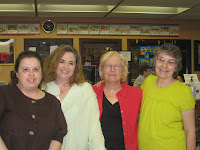
Stephanie Gallentine, Debra Calloway, Sue Watson, and Shirley Harkins
(missing Janet Brown)
 And the winner of our blog giveaway of REFUGE is...Allyson!
And the winner of our blog giveaway of REFUGE is...Allyson!Allyson, Stephanie, and Bethany
Subscribe to:
Posts (Atom)
Writing Tip of the Day
|
